
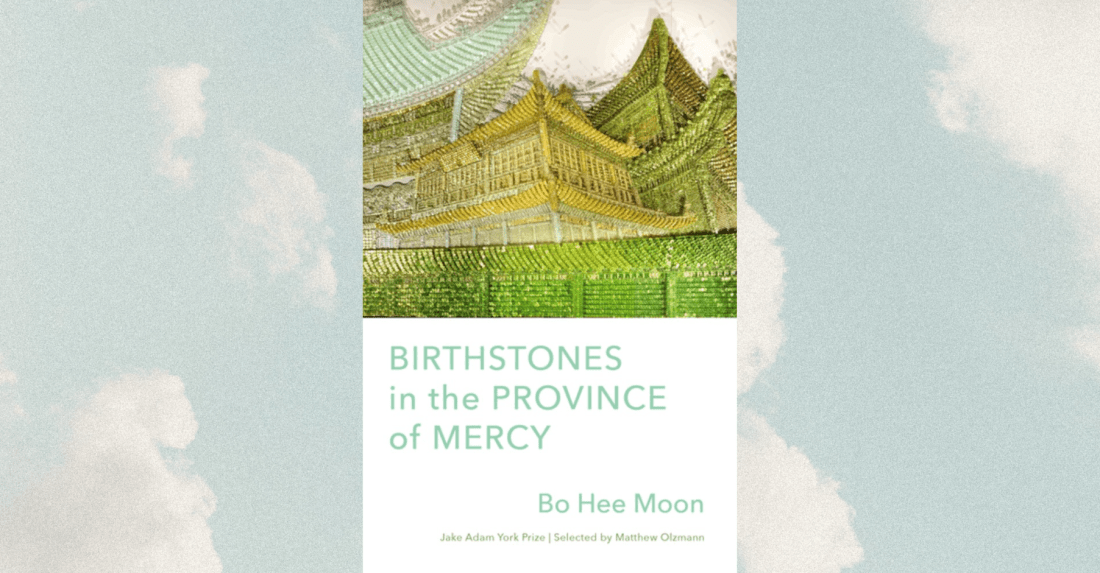
Bo Hee Moon’s Birthstones in the Province of Mercy is a collection of poems detailing the growing-up experiences of a Korean girl adopted into a Jewish-American family. Without ever directly criticizing either Korea or the US for their roles in what has become an increasingly scrutinized and criticized adoption enterprise, Moon’s poems express both a longing for the speaker’s birth mother and mother country and an ambivalence toward the “substitute family” (Moon’s term) she lived with in the United States. At the start of 2026, just weeks after the South Korean government’s declaration of an end to its overseas adoption initiatives, the release of Moon’s collection seems a masterstroke of kairos. Moon’s poems, which blend personal vignettes with elements of Korean culture and folklore, are by turns mournful and idyllic; heartbreaking and uplifting.
The poems in Birthstones in the Province of Mercy, many of which were published in top-tier literary journals prior to their inclusion in the collection, celebrate the speaker’s Korean heritage in a way that is both confident and curious. As a work of Korean diasporic literature, Birthstones seems a natural heir to Mary Kim Arnold’s Litany for the Long Moment (2018), which similarly details Arnold’s experiences as a Korean-American adoptee. Like Arnold’s book, Moon’s collection presents Korea both as a birthplace to be treasured and as a kind of unsolved mystery. Without ever seeming bitter or overly sentimental, the poems in Birthstones wield personal memory as a scalpel to past abuses even as they draw upon a collective postmemory to access what becomes a mnemonic cultural archive.
While each poem in Birthstones can be read independently, many of the poems fall into clusters that explore different motifs throughout the collection. Among the most powerful are the so-called “Letters to Omma,” which close the book and provide the culmination of the imagined dialogue the speaker has had with her birth mother throughout the collection. The first poem, “Letters to Omma—Meeting at the Midpoint,” begins, “감사합니다 gamsahabnida (thank you) / for giving me a better life / than I would have had in Korea. / I am aware of the great suffering you endured. / I do not know if this is right: I forgive you.” These lines voice one of the central conflicts of the collection: forgiveness, even as the speaker expresses intense longing and sadness for the mother she has never met, while also reasoning with her mother’s decision to give her up. A later poem, “Letters to Omma—How You Met,” imagines the meeting of the speaker’s birth parents, creating a bucolic and romantic scene full of picnics, rice paddies, and flowers that helps to balance out some of the collection’s darker moments. In “Letters to Omma—Music,” for example, the speaker emphasizes the challenges of living with her substitute family, writing “I was unsupervised / with my caretakers, a roach / on the motel floor.” Combined with passages throughout the collection that detail the sexual advances of the speaker’s adoptive father, this section, though uncomfortable, cannily details the environment of dysfunction and abuse in which the speaker grew up.
The collection also brilliantly integrates Korean images and symbols in ways that are original, surprising, and at times playfully clever. For example, the first poem in the collection—“Generosity Gwandae (관대)”—opens with the lines “My heartspace feels like a bitter fruit, / a meanness, turning to a sweet red-orange.” In contrast to these lines, the next line presents an image of sweetness: “hongsi (홍시) is a soft persimmon,” particularly one that is bulbous like a balloon and eaten in winter as a delicacy. The image of a hongsi is a very specific one, evoking a peculiar coldness and sweetness. Similarly, “Adoption File 1987” opens by describing desire in terms of “half moons, / and gyungdan (경단) / a black sesame rice / cake.” Korean rice cakes are various enough to comprise their own food group, making gyungdan—rounder, sweeter, and chewier than many other kinds of rice cakes and, in this case, coated with black sesame powder—a very compelling symbol. And the very solemn poem “Birth Hour—How to Name a Child” engages in wordplay worthy of Lewis Carroll with the lines “‘Night’” in Korean is not to be confused / with the Korean word for ‘room,’” punning off the similar-sounding bahm (night) and bahng (room). Many of the poems also mention rice cakes, animals, and other tidbits of Korean folklore that lend the poems a fabular quality that complements rather than clashes with the collection’s heavier realistic themes.
If any parts of the book gave me pause, they were the places where the explanations of Korean vocabulary seemed a tad heavy-handed. Admittedly, this may stem in part from my prior knowledge of Korean culture, having both lived in the country and studied the language extensively. Even so, I would have preferred fewer moments in which the language seems to shift into dictionary speak. Granted, these moments are sparse, and even when Moon is defining terms, she never loses her poetic flair. Even so, I appreciate when an author trusts context and conveys the meaning of an unfamiliar word, or else manipulates the language in a way that makes the act of defining almost invisible. For example, the poems never say, in so many words, that omma means mother—not because omma has become part of the English lexicon, but because the poems leave no room for any doubt as to its meaning.
While Moon’s publication record clearly demonstrates that the poems in Birthstones hold up on their own, the collection offers a bigger reading payoff than any individual poem. Read as a unit, these poems create an impression of the speaker as someone who, by straddling multiple cultures and suffering through a great deal of loss and abuse, has discovered her voice and spoken at the perfect moment. And throughout the collection, this voice never whimpers or wavers. It sings.
POETRY
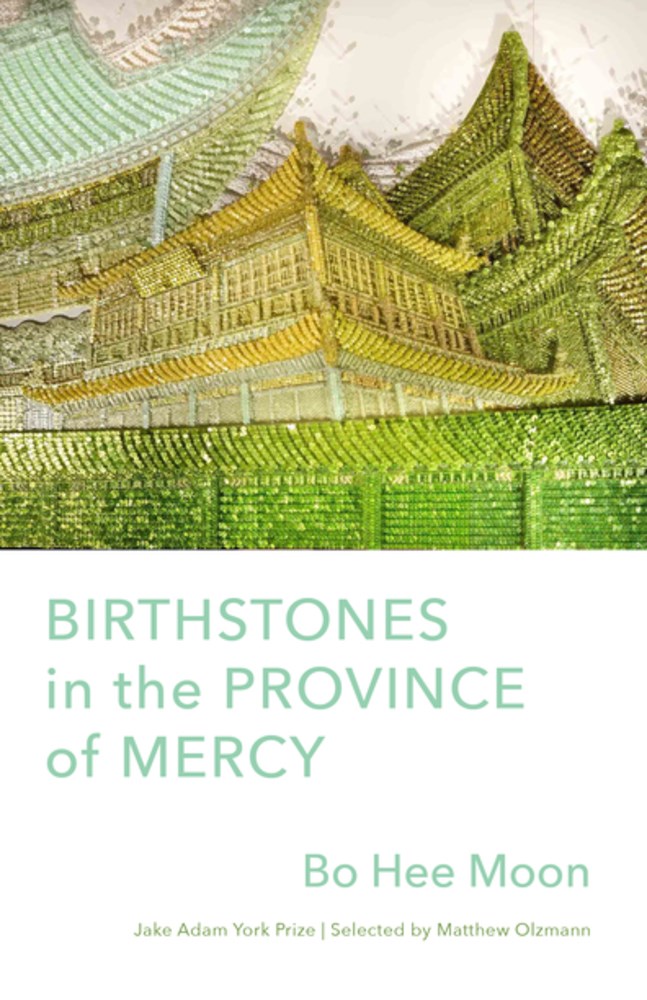
Birthstones in the Province of Mercy
By Bo Hee Moon
Milkweed Editions
Published January 6, 2026


